Namma Chennai Namma Neighbourhoods

Namma Chennai, Reimagining our Neighbourhoods presents the outcomes of the Localised Climate Resilience learning module undertaken by students of Sunnyside Learning School. Rooted in a place-based approach to education, the initiative encourages learners to understand climate change not as a distant global phenomenon but as a reality that is experienced within the neighbourhoods they inhabit. Through exploring their local environment, students examined how challenges such as flooding, heat stress, water scarcity, waste management, and environmental degradation intersect with everyday life and affect different communities in different ways. Their projects reflect observations, inquiries, and reflections on the ecological and social realities of their surroundings, with a particular focus on Palavakkam.
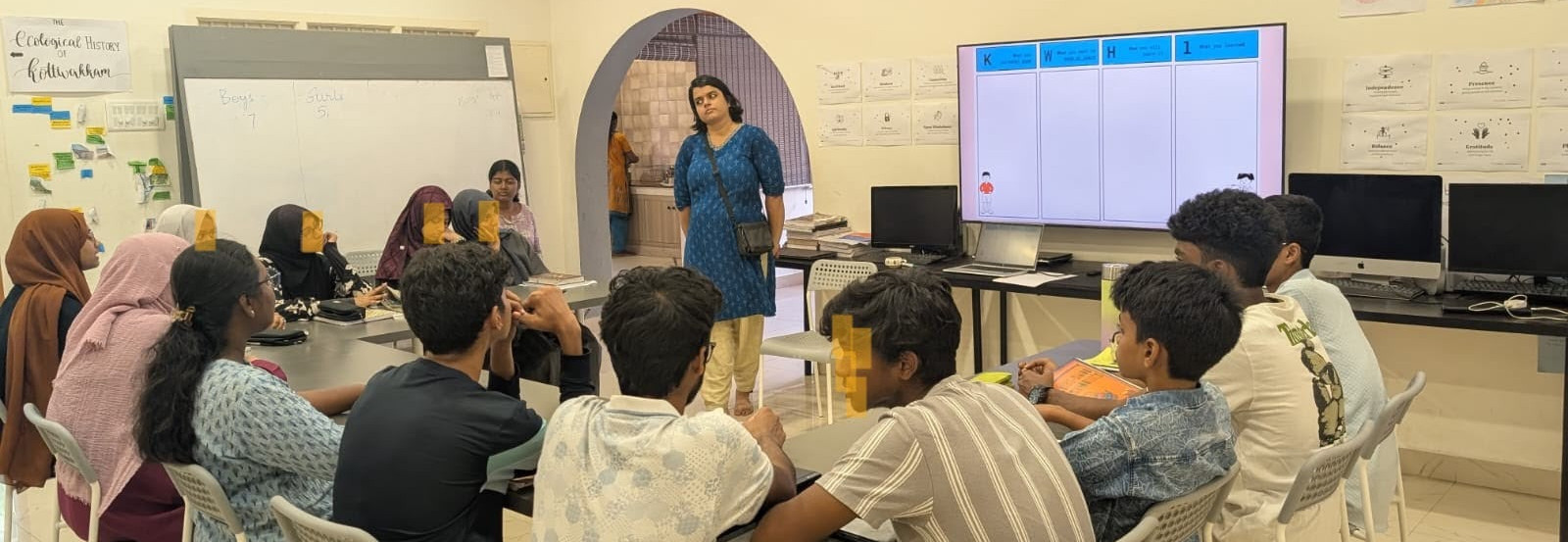
Developed over a three-month learning journey, the module combined field visits, community interactions, collaborative research, and creative exploration. Students engaged with local histories, mapped environmental challenges, documented community experiences, and imagined pathways towards more resilient futures. The works presented in this exhibition showcase their efforts to understand the relationship between people, place, and climate, while offering thoughtful and locally grounded visions for neighbourhood resilience. Together, these projects demonstrate the power of learning from place and highlight the role of young people as active participants in shaping sustainable and climate-resilient communities.
Redesigning Protective Clothing for Sanitary workers
By Noorul Huda

This project began with understanding climate resilience and work that would result in community impact in our neighborhood. My project looks at why sanitation workers don’t use protective gear even when it is given to them. From the survey and talking directly to workers in Palavakkam, it’s clear that the problem isn’t that the equipment isn’t available, it’s that it’s not practical to use. Most of the gear is uncomfortable, too hot, or not suitable for the kind of work they do. Because of this, workers end up not using it regularly. So the main issue is not just providing equipment, but making sure it actually works for the people who have to wear it every day. Talking to them helped me design protective gear and clothing for them. My view focuses on the material that is used for the clothing and protective gear.
Sustainable Sanitary Kit For Conservancy Workers
By Rumaysa Ibrahim
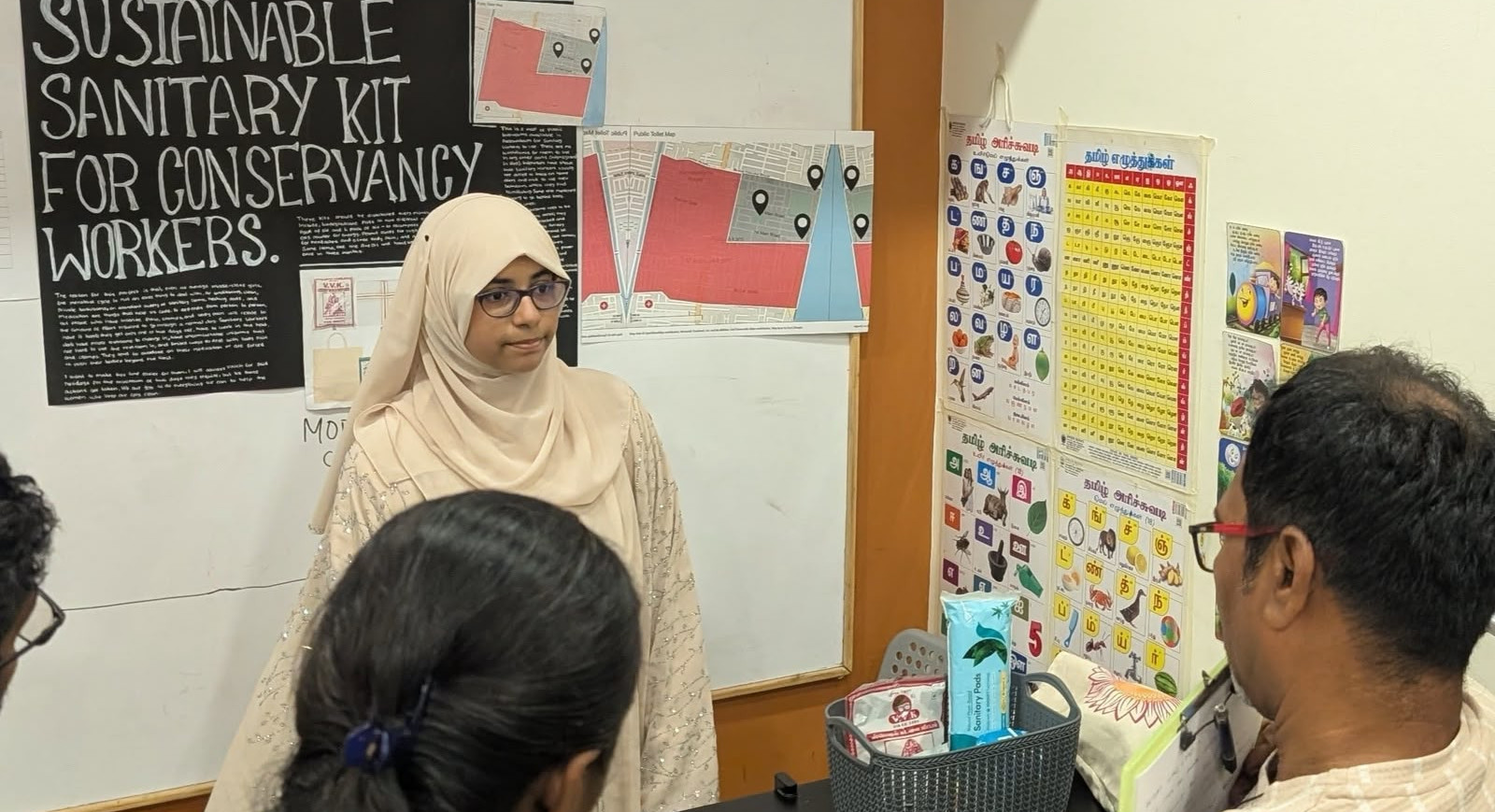
This Project is about Climate Resilience and Community Aid. In this context, I worked on a project that would supply Conservancy Workers with sustainable Sanitary Kits every month. The kit will include two different sizes of pad packets, a handkerchief, Axe oil, ORS powder and peanut candy all in a cloth bag. Besides the kit, this project focuses on availability of bathrooms built in our neighborhoods, specially for these workers. Currently, we could only map three bathrooms in Palavakam, and all of them were accessible to only a fourth of the Palavakkam locality on the beach side; neglecting cleaners working in other areas.
Heat Smart Bus Stop
By Shahidah Sara

The Heat Smart Bus Stop project focuses on redesigning the Palavakkam Bus Stop in Chennai to improve comfort during extreme heat. Through observation, key issues such as hot seating, lack of drinking water, and limited shade were identified. The project proposes simple, cost-effective solutions including a water station, removable side panels for shade, and cool roofing to reduce heat. It also includes awareness posters and digital support to help passengers avoid long waiting times. Overall, the design aims to make bus stops safer, cooler, and more comfortable for daily commuters in hot climates.
Comics for Awareness
By Muhammad Ashfaque

This project explores climate change through everyday experiences, mainly focusing on the effects of heat and humidity in urban areas. Instead of using data or detailed explanations, it uses a series of short, four-panel comics to represent real-life situations in a simple and clear way. The comics are based on common issues such as power cuts during extreme heat, lack of shade, water scarcity, and the general discomfort caused by humidity. These are things people experience regularly but do not always think about in depth. The project is based on observation and aims to show how these conditions affect different groups of people differently, especially those who are more exposed to them. Through visual storytelling and hand-drawn illustrations, the main intention is to create awareness and make people notice and reflect on these everyday environmental issues.
Mapping and Analysis of Playgrounds in the Palavakkam Vicinity
By Abdul Muiz Syed

This report assesses seven playgrounds and recreational spaces in Palavakkam, Greater Chennai, examining their suitability for sports and community use. Field observations evaluated factors including size, terrain, sports facilities, equipment, water, toilets, lighting, safety, and maintenance. The findings reveal significant differences, with well-maintained spaces such as VGP Layout Park and Kottivakkam Multi-Sport Park offering better infrastructure, while larger beachside grounds often have uneven terrain and limited facilities. The study concludes that maintenance, safety, and accessibility are more important than size alone, highlighting the need to improve infrastructure in less-developed playgrounds.
Combating Urban Heat Islands in Chennai
By Mansoor Ahmed

This project examines the growing Urban Heat Island (UHI) effect in Chennai, focusing on low-income households in Thiruvanmiyur Kuppam that experience significant indoor heat due to concrete structures, poor ventilation, limited greenery, and restricted access to cooling systems. A qualitative door-to-door survey of 10 households conducted in January 2026 found that concrete homes retain more heat than thatched structures, with limited awareness of affordable cooling alternatives. The study proposes practical solutions such as reflective roof coatings, terrace gardens, and tree planting to reduce heat exposure and improve thermal comfort. It highlights the need for greater awareness, government support, and affordable interventions, while recommending larger-scale research with quantitative temperature data.
Sanitation and Infrastructure Improvement Proposal for the Palavakkam Fish Market
By Abdul Musawwir Syed

This report assesses the Palavakkam Fish Market, a critical livelihood space supporting 7–8 women vendors from the Palavakkam Kuppam fishing community. Despite its economic importance, the market operates under poor conditions, with prolonged heat exposure, flooding risks, inadequate sanitation, limited access to potable water, poor waste management, and insufficient workspaces. These challenges compromise vendors’ health, safety, dignity, productivity, and income security. The report proposes practical, scalable, and sustainable interventions to improve infrastructure, climate resilience, sanitation, waste management, and overall working conditions at the market.


