Lost Goat in a Palmyra Forest
Updated: Oct 2, 2025

It was getting dark as we were returning from Karmegam anna’s palmyra groove in Kannirajapuram, Ramanathapuram district. We were surrounded by palmyra trees and my thoughts lingered around the plights of palmyra tappers producing Padani (Palmyra nectar) and Karupatti (Palmyra jaggery). We heard a tremulous voice of a goat kid lost from its herd. The goat herder was far inside the field and it was getting darker, so Karmegam anna decided to take the goat kid home and to return it to the goat herder on the next morning. As I was carrying the goat kid sitting in the back seat of Karmegam anna’s bike, it was trembling due to the fear of unfamiliarity but also reassured due to the warmth of Karmegam. We met eye-to-eye and it spoke to me, “I am safe now with a palmyra tree climber. Who is going to support, the lakhs palmyra tree climbers lost in the hustle of climate change, local money lenders and larger corporatisation?”
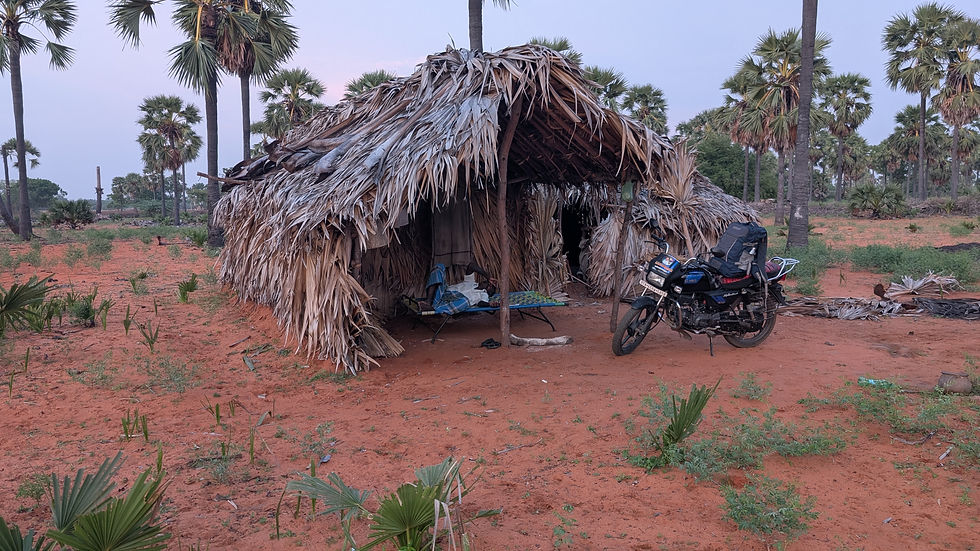
Karmegam is one among the estimated 10 lakhs palmyra tree climbers in Tamil Nadu. He has 5 acres of Palmyra groove with more than 100 trees and 10 goats. Palmyra tree climbers tap Padani (Palmyra nectar) from the tip of palmyra stem by collecting it in a slaked lime (sunambu) laced pot. The padani is used as a fresh drink as well but it is mainly used to make Karupatti (palmyra jaggery) by continuously boiling it in a large container and then cooling it in coconut shells. Every part of the palmyra tree from roots to leaves can be used to make hundreds of food products and home utility products.

Karmegam produces 15-25 kg of Karupatti per day during the peak season from February to May and around 10 kg of Karupatti per day from June to August. He toils hard in the scorching summer and climb each tree 3 times a day. His wife has an even more tedious job of boiling the padani using a firewood stove and producing Karuppatti. They stay in the palmyra groove itself during peak season and manage with very basic amenities. Karmegam’s family produces around 5000 kgs of Karuppatti every year and make a living out of it. They procure the slacked lime (sunambu) from Sayalkudi and pot from nearby potters supporting other nature-based livelihoods in the locality.

They used to cultivate dry land crops like groundnut, thatai payaru (Red cow peas), Ulundu (Black gram), Cholam (Sorghum), millets etc. during the rainy reason i.e. off-season for Padani in the palmyra grove for additional source of income. However, they are unable to do it since the last 10 years due to uncertainty in rain induced by climate change and lower yields. Climate change has also affected the Padani yields of the Palmyra trees and thus palmyra tree climbers are perplexed. Moreover, if the family has taken loan from the trader, they must sell the Karuppatti at a lower than market price exclusively to the trader to compensate for the loan.